
Tech Giants Envision a Future Beyond Smartphones
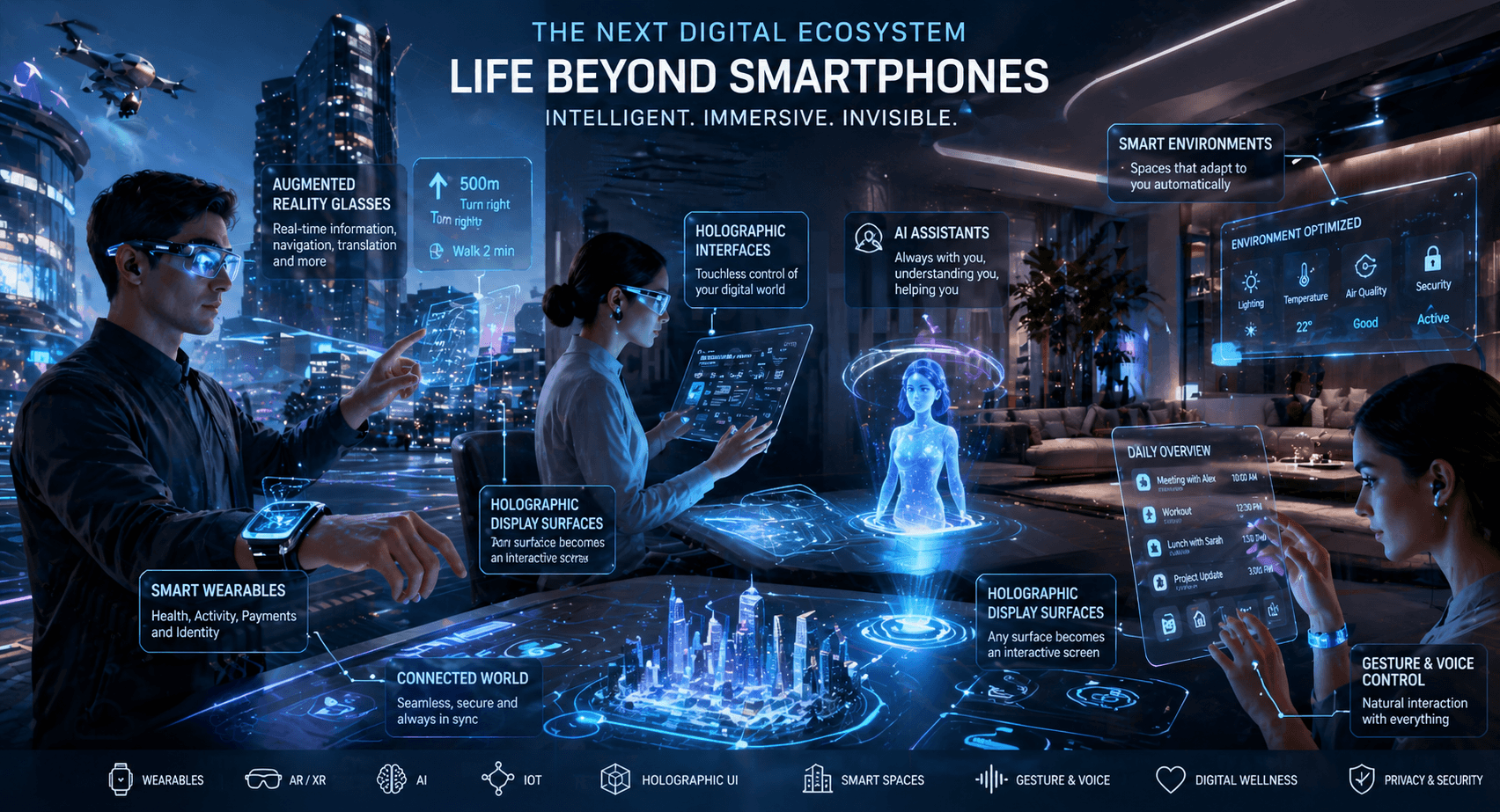
Tech giants are actively exploring a future beyond smartphones. As technology evolves, companies are shifting focus toward more immersive, intelligent, and integrated digital experiences.
Instead of relying on traditional mobile devices, the next wave of innovation is expected to center around AI, wearables, and spatial computing.
Why the Future Is Moving Beyond Smartphones
Smartphones have reached a maturity point where innovation is slowing. Therefore, tech companies are looking for the next major platform shift.
Users now demand more seamless and hands-free digital interactions. As a result, companies are investing in new computing models.
Key Technologies Replacing Smartphones
AI-Powered Wearables
Wearable devices are becoming smarter and more independent. These include smart glasses, earbuds, and health trackers powered by AI.
They aim to reduce dependency on screens while improving real-time assistance.
Augmented Reality (AR) Devices
AR glasses are designed to overlay digital information onto the real world.
Companies like Apple and Meta Platforms are investing heavily in AR ecosystems.
These devices could eventually replace many smartphone functions.
Voice and AI Assistants
AI assistants are becoming more advanced and conversational.
Instead of typing or tapping, users will interact through natural voice commands and contextual AI responses.
Spatial Computing
Spatial computing blends physical and digital environments.
It allows users to interact with 3D content in real-world spaces, creating immersive experiences.
Vision of Leading Tech Giants
Major technology companies are shifting their long-term strategies. They are focusing on ecosystems rather than standalone devices.
For example, Apple is working on spatial computing platforms, while Meta is building immersive metaverse environments.
Similarly, other companies are investing in AI-first interfaces that reduce screen dependency.
Benefits of Moving Beyond Smartphones
Firstly, it creates more natural and intuitive user experiences.
Secondly, it reduces screen fatigue and improves productivity.
Additionally, it enables real-time information access without physical devices.
Finally, it opens new opportunities for developers and businesses.
Challenges in Transition
Despite innovation, several challenges remain. High costs of new devices may limit adoption.
Battery life, privacy concerns, and user adaptation are also major issues.
Moreover, infrastructure changes are required for large-scale adoption.
Future Outlook
The transition beyond smartphones will not happen overnight. Instead, it will be gradual and ecosystem-driven.
Smartphones will still exist, but their role will likely decrease over time.
In the long term, AI-driven wearables and AR systems may become the primary computing platforms.
FAQs
Why are tech giants moving beyond smartphones
Because innovation in smartphones has slowed, and new platforms like AI and AR offer more potential.
What will replace smartphones
AI wearables, AR glasses, and spatial computing devices are likely successors.
Are smartphones becoming obsolete
Not yet, but their dominance may reduce over the next decade.
Which companies are leading this shift
Companies like Apple and Meta are leading development in AR and spatial computing.
What is spatial computing
It is a technology that blends digital content with the physical world in real time.
Conclusion
Tech giants envision a future beyond smartphones where AI, AR, and wearable technologies redefine digital interaction.
Although smartphones will remain important, the next era of computing will be more immersive, intelligent, and integrated into everyday life.