
US–China Technology Competition
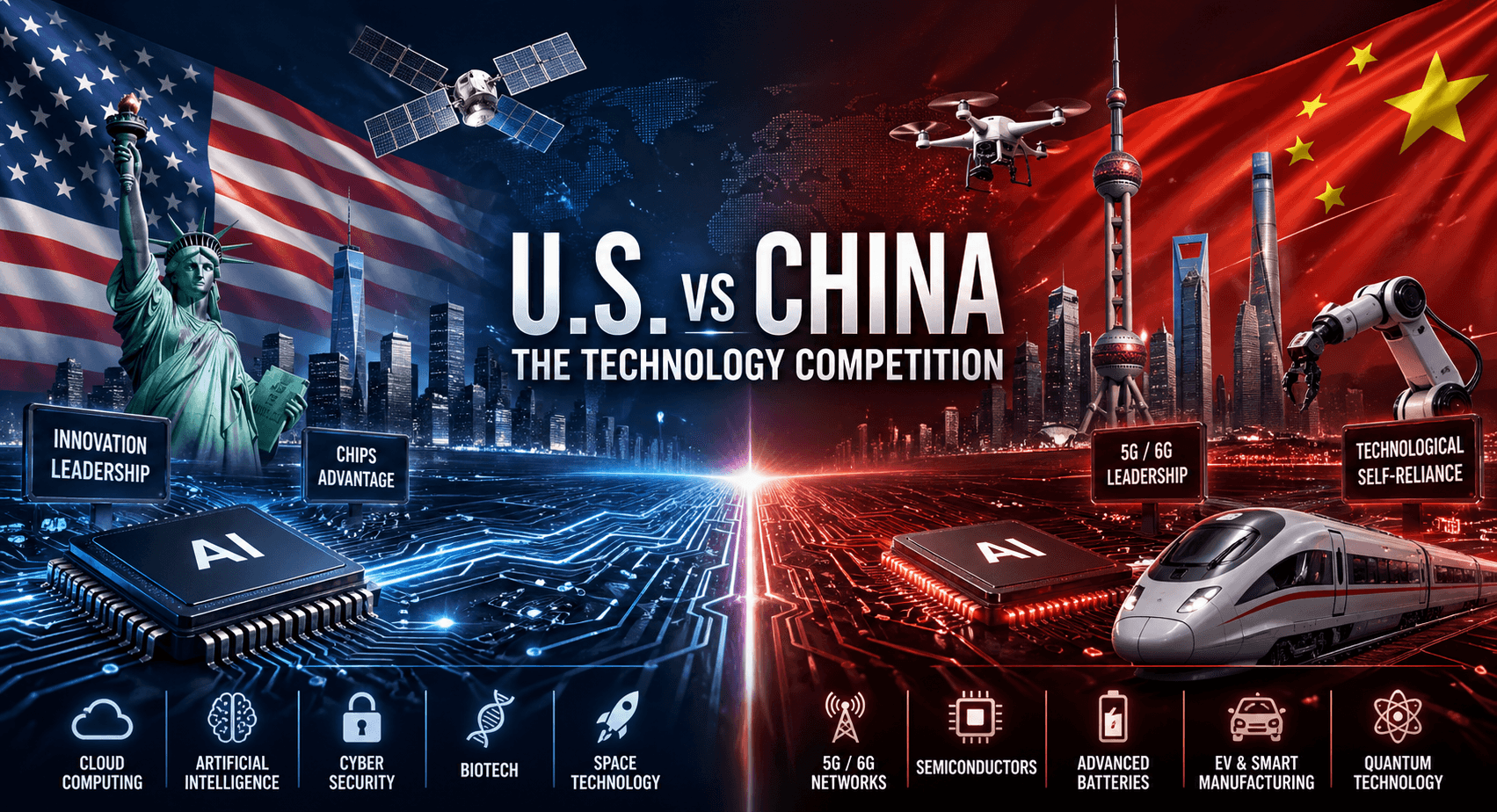
The US–China technology competition is one of the most important geopolitical and economic rivalries in the modern world. It influences artificial intelligence, semiconductors, telecommunications, and global innovation systems.
Business leaders, policymakers, and economists, including figures like Jamie Dimon, have highlighted how this rivalry could reshape global markets and financial stability.
What Is the US–China Technology Competition
The competition between the United States and China focuses on dominance in advanced technologies. These include AI systems, chip manufacturing, quantum computing, and digital infrastructure.
Both countries aim to lead innovation while securing economic and national security advantages.
Key Areas of Competition
Artificial Intelligence
AI is a central battleground. Both nations are investing heavily in machine learning, automation, and large-scale AI models.
The goal is to achieve leadership in productivity, defense systems, and digital services.
Semiconductor Industry
Semiconductors are critical for all modern technologies. The US leads in design, while China focuses on manufacturing expansion.
Supply chain control has become a major strategic issue between both countries.
5G and Telecommunications
Telecom infrastructure is another key area. Companies compete to build global 5G and future 6G networks.
This impacts data speed, connectivity, and national security concerns.
Quantum Computing
Quantum technology is still developing, but both countries are investing in research.
It has the potential to revolutionize encryption and computing power.
Economic and Global Impact
The US–China tech rivalry affects global supply chains and trade relationships. Many countries must align with one ecosystem or balance both.
It also influences investment flows, innovation speed, and market stability.
Role of Financial and Business Leaders
Business leaders like Jamie Dimon have warned about the long-term risks of technological decoupling.
Such competition may increase costs, reduce collaboration, and reshape global finance.
At the same time, it encourages innovation and rapid technological progress.
Strategic Implications
The competition is not only technological but also geopolitical. Countries are building alliances based on technology access and security concerns.
Export controls, sanctions, and investment restrictions are increasingly common tools.
Future Outlook
The US–China technology competition is expected to continue for decades. However, complete separation is unlikely due to global interdependence.
Instead, a dual-tech ecosystem may emerge, with parallel standards and supply chains.
FAQs
What is the US–China technology competition
It is a global rivalry between the US and China to lead in advanced technologies like AI and semiconductors.
Why is technology competition important
It affects economic growth, national security, and global innovation leadership.
Who benefits from this competition
Both countries gain innovation advantages, but global markets may face uncertainty.
What role does AI play
AI is a key area where both nations compete for leadership and strategic advantage.
Will the US and China cooperate in technology
Some cooperation exists, but competition and restrictions are increasing.
Conclusion
The US–China technology competition is shaping the future of global innovation. It influences industries from AI to semiconductors and impacts economies worldwide.
As the rivalry continues, businesses and governments must adapt to a rapidly changing technological landscape.